
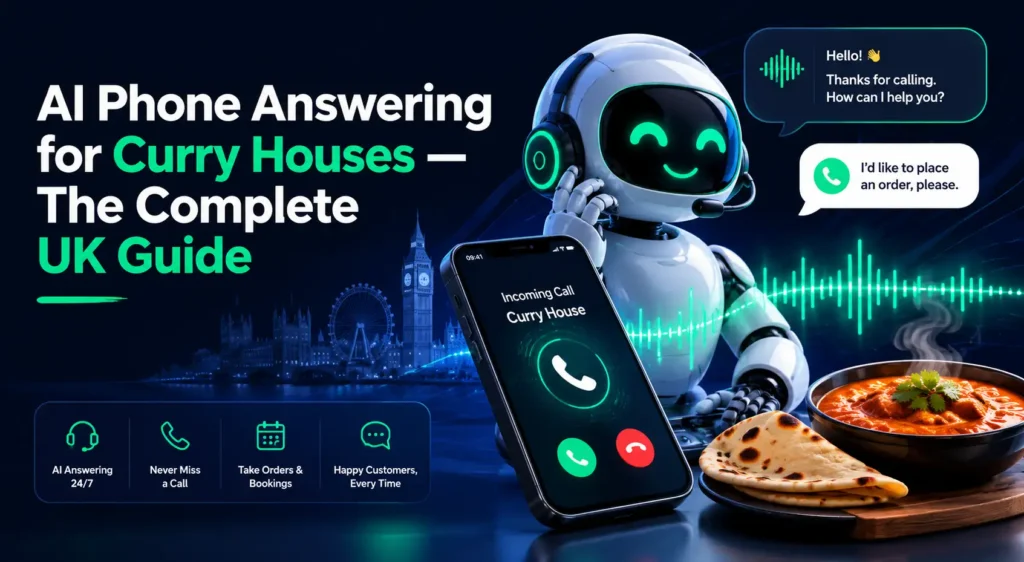

If you own a curry house in the UK, it’s a universal truth that your call volume aligns perfectly with your order volume during peak hours. On a Friday or Saturday night, your call volume is tight. It’s neither a management nor a personnel problem. It stems from your operational structure. An improperly constructed system leads to incorrect orders, directed calls to your nearest competition, and wasted revenue from customers who don’t call again.
In this guide, we will explain the use of AI phone answering for Curry Houses UK and the necessity for phone operators when it comes to curry orders and curry house revenue, the complexity of curry orders, and the ability of an AI phone answering service like Callopa to cover your call volume and how it sends you order confirmations to your WhatsApp.
Key UK trend: Indian food ranks among the top trending searched categories for UK food. It’s a strong constituent of demand and revenue, but only if you answer the phone.
The Legacy of the Curry House in the UK
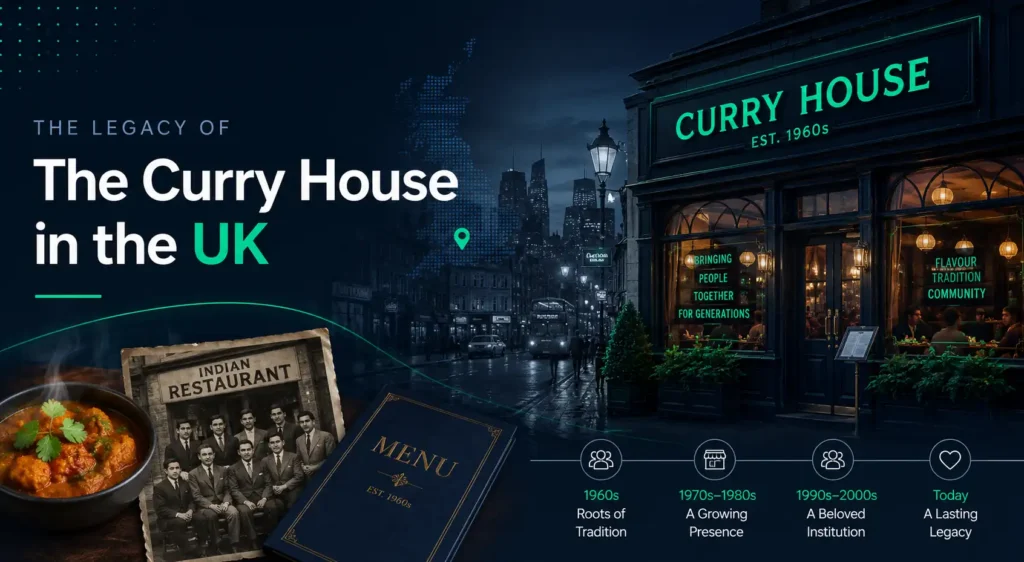
A curry house refers to establishments located in the UK whose primary focus is Bangladeshi, Indian, or Pakistani food. Generally, fine dining restaurants bring the food to the customer in the dining room. For curry houses, customer dining is more of a sideline to the business of takeaway food.
Ever since the British colonised South Asia, the UK curry house food scene has significantly changed. Where curry houses would primarily serve saag, chana, masala, and chicken tikka, now one can consume a full Biryani, including the signature dish of the UK, the Balti. As of today, the most popular food in all of the UK, and practically in all of the populous cities (Birmingham and London), is Indian food.
Though the cuisine and customer focus may have evolved, the model of operation houses still run on the same principles. Many restaurants may still run the business on a landline, where the front-of-house staff are responsible for simultaneously cooking, taking, and serving orders to the dining customers.
Though the customers have long-standing expectations, most curry houses still have the same legacy systems that do not satisfy the fast-paced, on-demand universe of present-day buying culture. Change and innovation are required. Perhaps one of the most revolutionary ideas is AI phone answering for curry houses in the UK.
Why Phone Orders Still Dominate Curry House Revenue
Curry houses choose phone orders over delivery apps for many reasons:
- Higher Profits: Delivery apps take 25-30% of total sales. Taking orders over the phone gets the restaurant 100% of the sales.
- Customer Information: With phone orders, curry houses collect customer data for loyalty and marketing.
- More Options: Customers have more options over the phone. Delivery apps have set restrictions, but phone orders can be more flexible.
That is one of the reasons why AI phone answering for Curry House UK is more of a need than a want. If a restaurant does not answer the phone, a customer will call the restaurant next door.
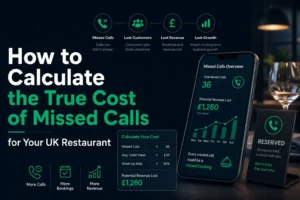
To see how much UK restaurant sales are lost, see our Missed Call Breakdown.
The Complexity of Curry House Orders
Unlike ordering from most restaurants, a curry order is much more in-depth for many reasons.
- Spice Level: Choose from 5 spice levels. Mild, medium, hot, very hot, and extra hot.
- Main Ingredient: Choose from many proteins. Chicken, lamb, mutton, king prawn, paneer, tofu, and more.
- Curry Base: So many choices like Korma, Madras, Rogan Josh, Jalfrezi, or Pasanda.
- Health Concerns: Gluten-free, dairy-free, vegan, nuts, etc.
- Food Additions: Add naan, choose between types of pilau, steamed, and biryani rice, and top it off with poppadoms and chutneys.
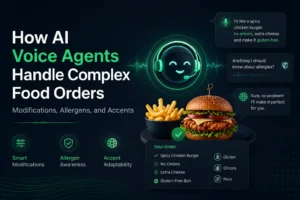
Mistakes from high-pressure environments are unavoidable. For example, a customer wants a “mild korma with garlic naan,” and human error can understand that as “medium karahi with plain naan.” This results in waste of food being prepared, a complaint being addressed for a refund, or a wrong meal being served due to possible allergens.
An AI phone agent can change how these things happen. Instead of trying to clarify a customer order, they can ask and confirm with the customer. The AI can then figure out the order and the components and dietary concerns that go into the order. This helps ensure that the kitchen gets the order exactly how the customer wants.
How AI Handles Complex Dietary and Order Requirements
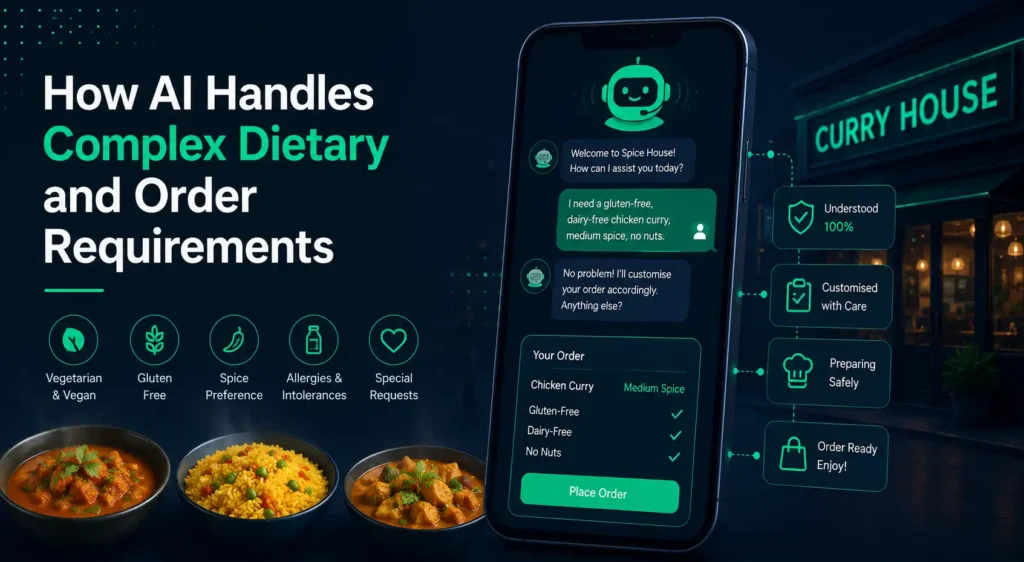
Callopa’s understanding of conversational commands is based on its ability to process natural language. An example Callopa uses is the ability of the system to capture complex instructions when callers order, “Make the Chicken Jalfrezi mild and gluten-free.”
Callopa uses structured confirmation loops to order processes. Once the AI phone receptionist collects the instructions, it is repeated to the customer for verification: “Confirming your order is Chicken Jalfrezi mild, gluten-free; is this correct?” This is an essential process for accuracy.
Since the system understands the logic of restaurants, it can process the relationship between different menu items. In the case where a customer adds a chilli to a dish in the system which cannot support it, rather than processing an impossible order, the AI would flag to seek clarification for that particular order.
This system is a way of ensuring that the order given to the kitchen is accurate. From a liability perspective, the AI phone ordering system protects a restaurant. There are serious health consequences that can be caused by the incorrect logging of allergens. By standardising the process of intake, AI phone answering for Curry House UK offers a similar system of intake to protect their customers and the restaurant from possible allergens.
Voice Recognition and Menu Navigation
One problem that many restaurant owners express is that people in the UK have different accents. Many curry houses serve different communities where customers speak English as a second language or have very strong regional accents. Traditional solutions process things wrong or miss a whole word, which causes the older system to call a “Bhuna” a “Boona”, or miss a number entirely.
Callopa is made especially for curry houses. South Asian menus often have names of the dishes in Hindi, Urdu, and regional languages. This AI ordering system is made to walk the users through the menus and confirm their selections for accuracy.
In the process, the focus is on merging clear and verbal interactions within the context of UK catering English instead of attempting to do language translation on the call. The AI phone answering for curry houses is programmed to listen for the words tikka, masala, samosa, lassi, and verbal commands and correlate them to the actual stock list of the restaurant.
Real-Time Integration: WhatsApp Notifications
The biggest competitive edge for Callopa is how orders are processed. Callopa orders your team without needing hardware, graphic interfaces with your POS.
Once confirmed, order details are processed and sent to the restaurant manager or owner on WhatsApp. This allows your team to tackle order fulfilment firsthand and eliminates the need to invest in or establish POS-integrated middleware.
This method includes the following:
- Alerts: When a WhatsApp order is processed, your team is notified via phone vibration.
- Visual confirmation: WhatsApp orders are sent in text, complete with special or customised notes from customers.
The system is designed to be as simple as possible. Callopa doesn’t require any IT staff to load plugins, and it doesn’t require your kitchen staff to go through tough training to understand complicated POS screens. To see your team’s ticket, simply go to your WhatsApp and see what is in the queue and see the operational flow as a ticket to be cooked.
Birmingham: The Epicentre of the Opportunity
Birmingham is one of our most important markets for our solutions, with Callopa, which is built specifically for South Asian restaurant communities across the UK, starting in Birmingham. The opportunity represented by the missed calls issue is high with Birmingham being home to the UK’s biggest South Asian restaurant community.
The areas of Ladypool Road, Sparkbrook, Small Heath, and Handsworth contain the highest concentrations of curry houses and Indian restaurants in the UK. The restaurants that answer their calls are winning. The restaurants that don’t are losing customers to the restaurants next door.
Birmingham is the birthplace of the Balti, and is proud of it. Because of that reputation, there is strong rivalry, and every missed call gives a neighbouring restaurant the chance to capture your customer base.
Local Opportunities
Independent restaurants in Birmingham collectively lose thousands of orders every week to unanswered calls during peak hours.
Tens of thousands of pounds in lost revenue might result from a typical Sparkbrook family-run curry restaurant missing 20 calls every week. Here, putting in place an automated system is a survival tactic rather than simply a technological upgrade.
The restaurant that answers the call gets the order. It is that simple.
Bradford: A Northern Stronghold of Curry Culture
Bradford is one of the UK’s most famous curry cities, with a strong network of independent South Asian restaurants. Areas like Manningham Lane, Great Horton Road, Leeds Road, and Lumb Lane are known for their high concentration of busy curry houses.
Competition is intense, with many restaurants located close together and serving similar menus. Customers often decide quickly, and if one restaurant doesn’t answer the phone, they will simply call the next one nearby.
For Bradford curry houses, especially family-run businesses, every call matters. Missing calls during busy periods can mean losing regular customers and daily revenue to competitors just down the road.
Callopa Pricing and ROI Analysis
Balancing an investment on price vs. potential return can be challenging. Callopa provides clear pricing for SMEs. There are no hidden fees for setup and no binding contracts.
Callopa pricing plans:
- Starter: £149/month
- Growth: £299/month
- Professional: £499/month
- Enterprise: £899/month
These pricing options are worth the estimated revenue recovery for full call coverage. Let’s break this down: with an average takeaway of £25, recovering four lost calls equates to the subscription of the Starter plan. Twelve calls, on average, justify the Professional plan subscription. It’s common for restaurant subscriptions to be recovered within the first week, given the volume of prior lost calls.
Stop Losing Orders Before You Start Cooking
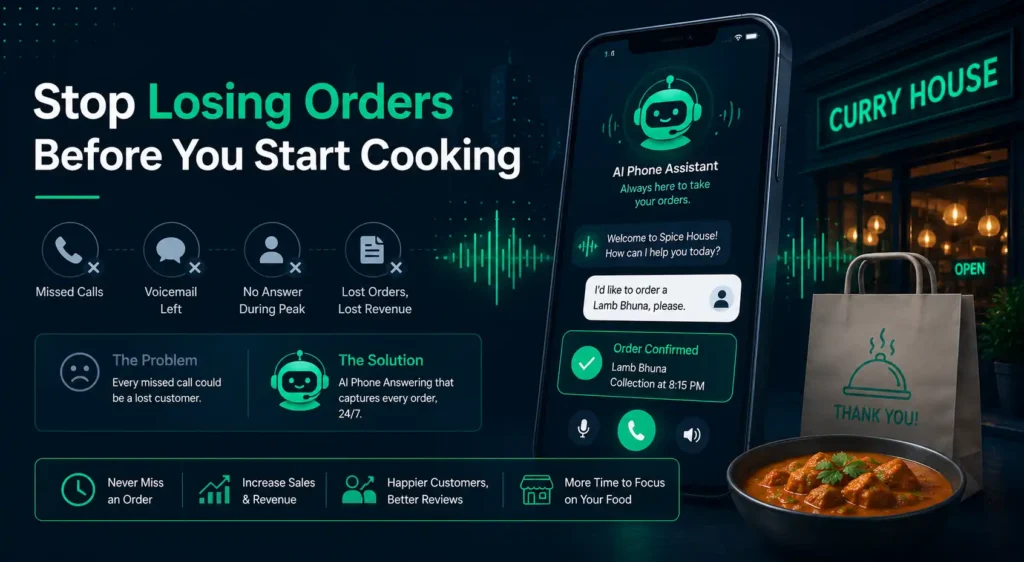
Who answers the phone can make the difference between a successful curry house and one that is struggling. Your direct order customer base is central to your profitability, and if it is gone, there is realistically nothing you can do.
Missed calls are more than simply an issue for the administration. They directly affect your revenue line. In the UK, and especially in Birmingham, the restaurant that wins is the one that answers every phone call.
Callopa offers the technologies necessary to guarantee that every call is received. It automates the method that is most important to your earnings, from the initial greeting to the last WhatsApp confirmation. Answering the phone is the first step toward steady growth, regardless of whether you require the Enterprise solution for multi-location administration or the Starter plan to control overflow.
Book a Free Demo
If you want to improve phone answering for Curry House UK, capture missed orders, and order precision while the staff focuses on service, see Callopa in action.