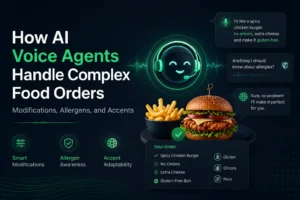


Every Friday night, your kitchen is full, your staff are flat out, and your phone will not stop ringing. Some calls get answered. Most do not. This guide explains exactly how AI voice agents handle the calls your staff cannot, taking complex orders, managing allergens, understanding accents, and getting every detail right.
In the UK, phone ordering is a basic part of restaurant tasks, especially with takeaways. Orders must be placed and received with a thorough understanding and accuracy. If customers get different results from this, they simply stop and move on. This puts pressure on staff who are already rushing between cooking, serving, and potentially delivering their meals.
An AI voice agent like Callopa is designed to take this burden off you. It is made to serve the ordering process and reduce the pressure of taking the bulk/work from you.
The Customer Experience During Phone Orders
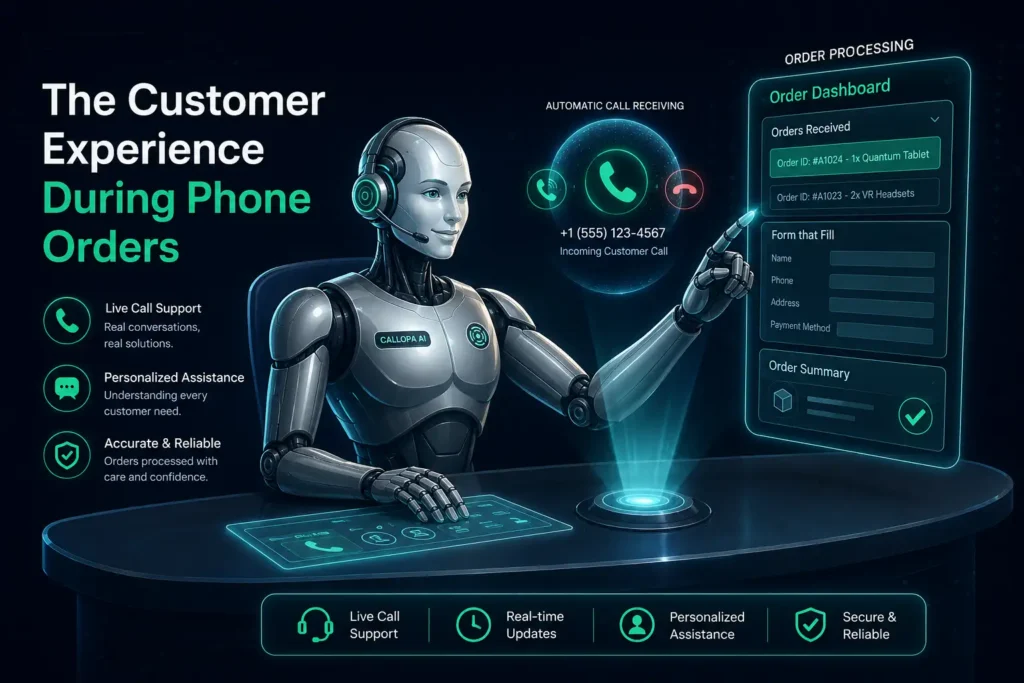
When you receive a phone call to place an order, customers typically expect three things:
- A fast response
- A clear understanding of the order
- An accurate order confirmation
However, this is far from the case in reality. At peak times, your staff:
- Prepares meals
- Manage any needed deliveries
- Assists other customers
Answering the incoming phone calls becomes impossible.
This ends up in the following:
- Missed calls
- Rushed order confirmations
- Order inaccuracies
This is what a typical customer might say:
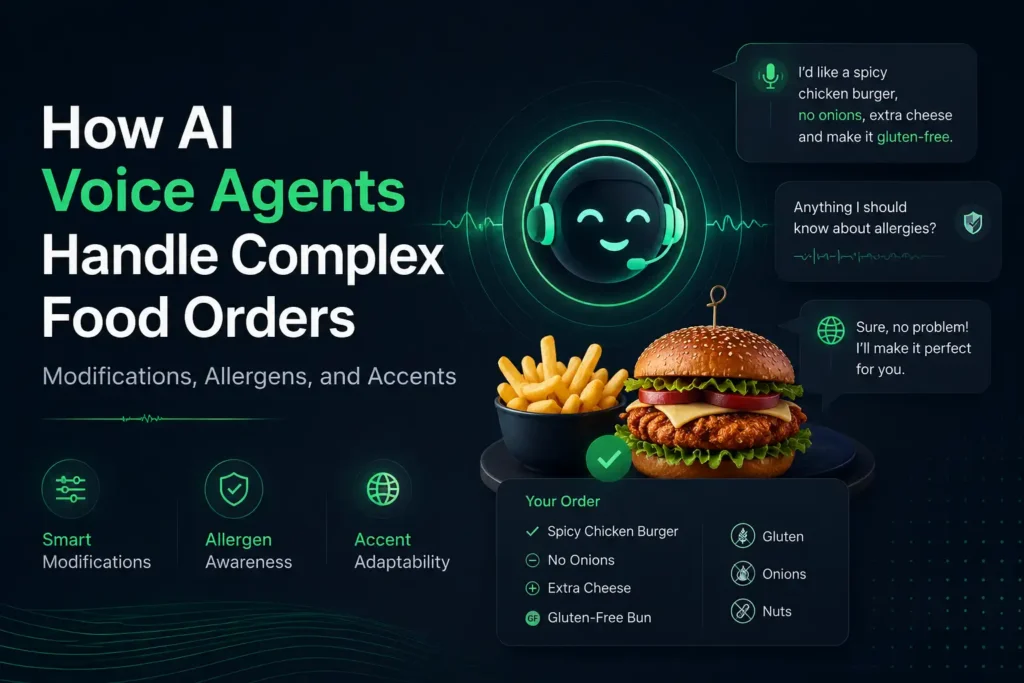
“Can I get a chicken karahi, with the medium spice level, no onions, and, if you would, please, make the order gluten-free?”
This is a single order that contains:
- A specific request on spice
- An ingredient to modify
- A dietary restriction
- Dish selections
The handling of this is complicated, especially if the same kind of requests come from customers. AI voice systems, like Callopa, are made to handle precisely such types of situations. If you would like to understand the financial side of this issue, make sure to read our blog on missed calls revenue.
Why Complex Orders Break Traditional Phone Answering
These factors typically contribute to the complexity of food orders:
1. Modifications and Customisation
When customers order things to be “extra spicy” or “with no onions,” or make similar requests are normal instructions. Real modifications include:
- Removal of ingredients (e.g., no onions, no garlic, no coriander)
- Addition of ingredients (e.g., add extra chilis, extra sauce, or extra cheddar)
- Component substitution (e.g., switching your fries to a salad or rice to naan, changing your beef to chicken)
- Requests for cooking to be more fully done, fully cooked, done with more oil, or less oil
- Portion styles (e.g., half-and-half style pizza, a mixed grill for two)
2. Allergens and dietary preferences
Allergen instructions are more complicated than just ordering “extra sauce.” Allergen instructions include:
- Specific requests (e.g., “no peanuts,” “no gluten”)
- Clear policy language (e.g., explaining that a restaurant would be making an unsafe promise by meeting certain requests)
- Immediate and appropriate tagging that alerts the kitchen directly
3. Accent, dialects, dish names
UK restaurants manage dialects and have to deal with:
- Every regional UK accent
- International accents
- Poor connections
- Noisy environments
- Dish without standard English pronunciation
This incorporation of accents is actually why the latest AI systems use more context and confirmation than relying only on speech-to-text.
Handling Order Modifications in Real Time
Ordering flows built with a good AI phone ordering system like Callopa modify structured data, not an incoherent mess of text. This approach does three things. It:
1. Identifies order modification
Examples:
- “No onions” → removal
- “Extra spicy” → intensity level
- “Gluten-free” → dietary constraint
- “Swap fries for salad” → substitution
2. Assigns the modification to the appropriate item
This part of the system is the most important. The AI phone receptionist must know if “no onions” applies to:
- the curry
- the burger
- the entire order
- one of two identical dishes
Stronger AI phone answering systems like Callopa will ask exactly one of the two identical portions
- “Is that no onions on both, or just one?”
3. Validates by order read-back
The AI phone ordering will put the order in the kitchen, like:
- “Burger 1, no cheese. Burger 2, no mayo.”
- “Chicken curry, extra spicy, no onions.”
This is how you reduce remakes: you focus on being consistent, which is far more important than being clever.
Managing Allergens and Dietary Requirements
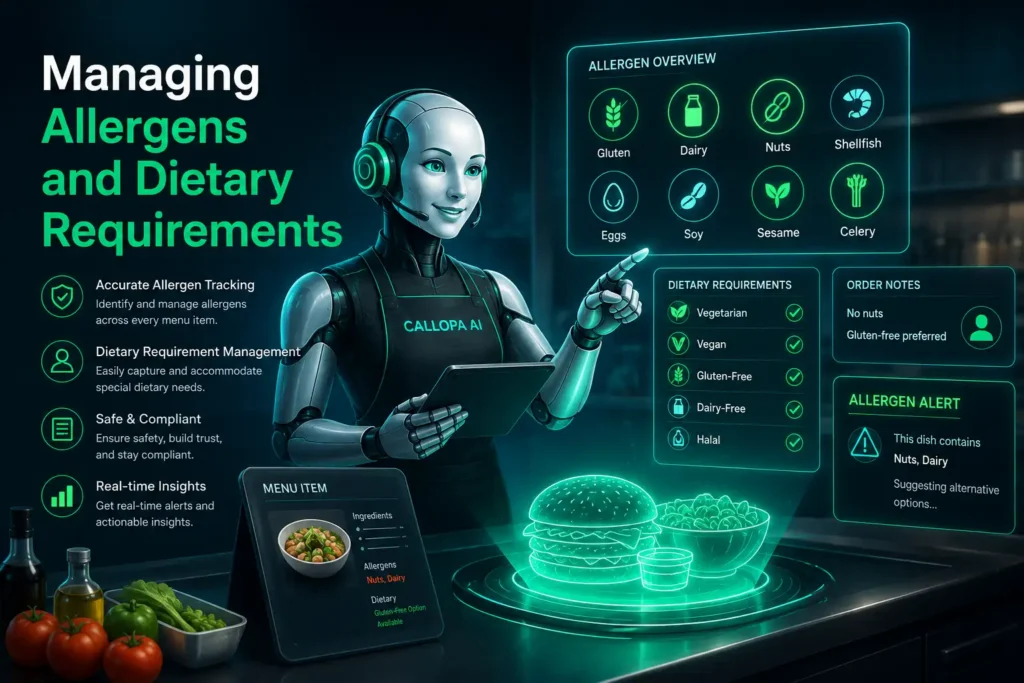
Allergens and dietary requirements are one of the most sensitive issues in the restaurant industry. Customers need to understand the potential risks so that they may make informed decisions in the ordering process. Clear and open communication is essential so that no mistakes are made.
What should AI do well?
- Inquire about the customer’s allergies and ask them to specify.
- Confirm their allergies during the read-back.
- Add the note to the restaurant to ensure it’s remembered.
What AI should not do?
- Don’t promise safety where the restaurant cannot guarantee it.
- Don’t guess food ingredients that aren’t documented.
- Don’t skip confirmation.
AI is not a substitute for communication. It’s meant to improve communication. But the restaurant is ultimately responsible for allergy safety. However, improved communication helps both the restaurant and the customer.
Order Confirmation and Read Back Accuracy
One way to maintain accuracy is through the confirmation loop. After the customer order is taken, the AI phone ordering agent collects additional modifications. Then, it confirms the order back to the customer.
“Just to confirm: One chicken tikka, two naans, garlic flavour, mild spice, and delivery to 123 High Street. Is that correct?”
This step is the best check for accuracy. If the answer isn’t correct and the customer wanted “spice” and not “mild,” then the customer can give that answer. If the AI system failed the confirmation loop, the order mistake would be caught upon delivery.
The AI phone ordering system for restaurants removes complaints by confirmation at the point of capture. Once the customer gives a verbal confirmation, the AI phone agents now see the transaction as complete.
What Happens When AI Cannot Understand
Speech recognition technology may never match human understanding, particularly under the following edge case conditions: poor call quality, background noise, or unexpected requests. Some examples are:
- Unfamiliar dish names
- Unclear sound
- Overlapping conversation
- Interruptions that alter the topic of conversation
In these examples, AI voice agents follow a simple recovery framework like:
- Asking the customer to repeat
“Sorry, but could you repeat that?”
- Asking a more narrow question
“Was that (‘chicken’ or ‘lamb’?)”
- Offering a more limited, defined choice
“Do you want (mild, medium, or hot?)”
- Confirming the partial understanding of that information
“I’ve got two garlic naans. What was the main dish?”
Capturing the intent is still the most important thing in Callopa. The system marks an ingredient for human evaluation if it cannot be processed. This indicates that the AI phone ordering agent, like Callopa, is suitable for a large number of callers and does not necessitate upgrading. Instead of staying by a phone prepared to pick up every conversation, this efficiency enables staff members to stay dedicated to the kitchen and dine-in customers.
WhatsApp Delivery to the Restaurant
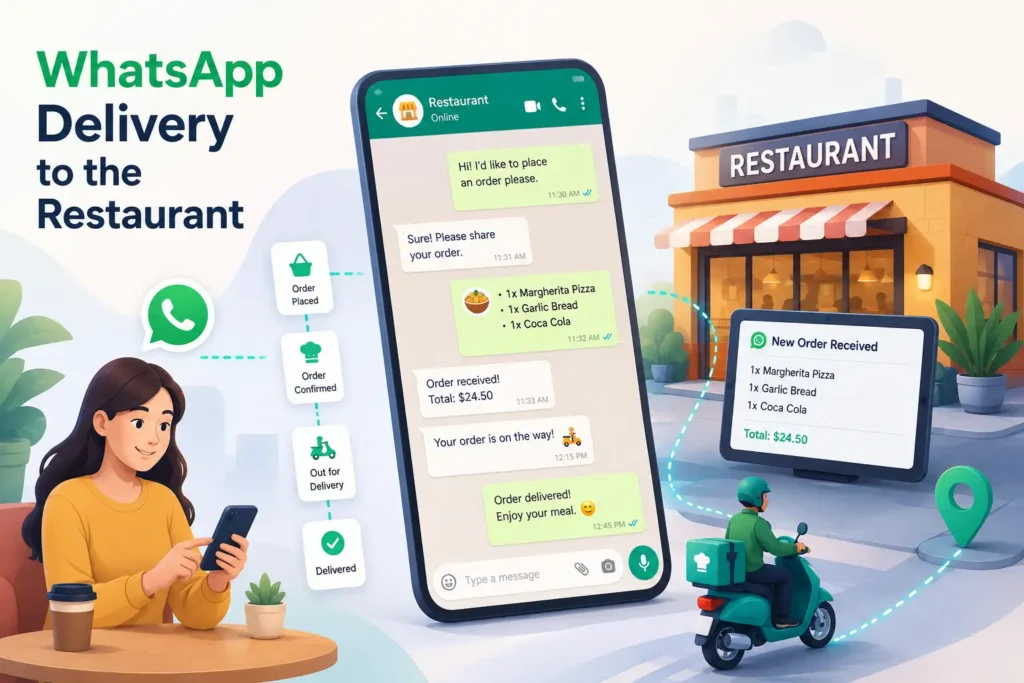
Callopa focuses on restaurants that demand that calls be answered consistently and that orders be captured instantly during the peak hours of service. Here are the key details in operation:
- Callopa answers the inbound calls.
- It takes the order and confirms it on the call.
- Finally, the confirmed order is sent to the restaurant owner via WhatsApp.
There is no need to integrate the POS, and Callopa does not require the customer’s credit card over the phone. The point here is speed, accuracy and simplicity of operations; the restaurant’s team gets the order details the moment the order is taken.
Human Like Conversation Quality
Modern AI voice agents are designed to be human-like conversational. Customers are free to communicate the way they like. For example, they may order like they do today.
With its advanced pacing and tone, Callopa is designed to create a comfortable interaction with customers. It is engineered to politely respond to the customer’s questions, interruptions, and the need for direction.
The AI phone ordering system creates the impression that customers are engaging with another human being rather than a machine. When conversations flow naturally, customers complete their orders without any difficulties.
The system provides another benefit through its ability to deliver consistent service. It provides equal service to all customers at any time and during any work capacity.
Why This Matters for UK Restaurants
The UK restaurant market is a highly competitive industry with evolving demands. In a phone order takeaway business, phone orders are one of the most important components.
Missed calls, wrong orders, and communication problems affect the business’s income and the customers’ satisfaction. Most of these problems are capacity-related and not staff-related.
By capturing takeaway orders, AI voice agents solve the communication gap by maintaining the business’s capacity, which means every call to the business is answered.
AI agents are not a replacement for the staff; they assist by undertaking the more repetitive and urgent tasks. This is important as the restaurant business involves a lot more than communication.
This allows restaurant teams to focus on food preparation and service, maintaining a high standard of communication with their customers.
Why Birmingham Restaurants Need AI Phone Ordering More Than Anywhere in the UK
Birmingham is a city in the UK with lots of restaurants competing with each other, especially with independent takeaways as well as curry houses. Understanding how AI takes restaurant phone orders in the UK is crucial, as demand is increasing and competition is high.
Many restaurants on Ladypool Road, Small Heath, and Sparkbrook are within a short distance. When a restaurant fails to pick up a customer’s phone call, they do not wait or leave a voicemail. But simply move on to the next competing restaurant in line. This creates more pressure for a restaurant to face with a phone line during the peak hours.
An AI phone answering like Callopa answers every call, and takes every order, even during rush hours. This system takes every order with great accuracy, with no need for staff, and reduces the risk of customers being lost to nearby competitors.
The ability to answer customer calls at all times brings financial benefits to businesses that operate in Birmingham’s competitive takeaway area.
Pricing and Accessibility
If you are exploring the pricing of Callopa, here is the list of plans without a setup fee or contract:
- Starter = £149/month
- Growth = £299/month
- Professional = £499/month
- Enterprise = £899/month
Book a Free Demo
Want to experience Callopa in a UK phone order system, modification management, allergens, and managing order calls? Book a demo and test it with your own menu.