

There are several Chinese food delivery services and restaurants across the UK, and Chinese food is almost always within the top 3 food types per major city in the UK that people search most often for. That means your restaurant does not have a demand issue. It has a capture issue.
Every Friday and Saturday night, while your kitchen is fully active, something silent is happening in the background:
Your phone is ringing… and not every call is being answered.
Not because you are not busy. Because you are too busy.
And that is where revenue disappears.
- 47% of the calls made to Chinese food restaurants in the UK are not answered.
- Almost all of those, which is 85%, never call them again.
- 62% of them are actually customers who go and make purchases from your competitor.
That means this issue does not lie with the staff. This is a failure of your systems. That is the reason why the search term “AI phone answering Chinese restaurants UK” is so relevant.
Missed Calls Are Silent Revenue Leakage
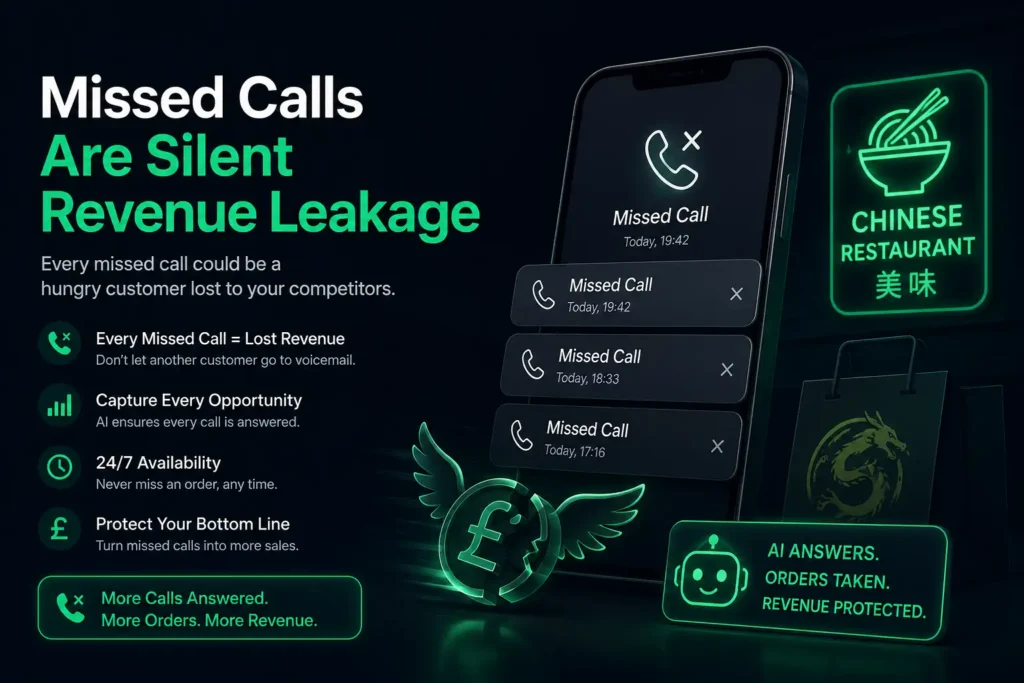
Chinese takeaways associate revenue leakage with different components of the business, such as food cost, delivery cost, staff inefficiency, etc.
The reality is that the major loss happens elsewhere, long before an order is taken. It happens on the phone. During peak hours:
- Orders are received and processed at a rate the staff cannot sustain.
- Customers hang up after 10-15 seconds because the staff is preoccupied with incomplete orders.
- The missing calls are losing customers.
The UK consumer behaviour is even simpler. If no one answers after the first call, they think it is too busy and call the next one. This one single behaviour costs the industry billions.
Why Does It Happen? The Reality of Chinese Takeaways in the UK
Chinese takeaway restaurants simply cannot operate the same way UK food businesses do, because they focus on high customisation, high speed, and high volume. This leads to these main problems.
Customisation Pressure
Customers hardly ever place a simple order. There is always a request to leave out a component on a dish or to add multiple components. Such as:
- No onions
- Extra sauce
- Spice adjustments
- Ingredient swaps
That means, with each call, the staff is about to enter negotiations, instead of just taking orders.
Peak Hour Pressure Creates System Failure
Most Chinese takeaways are busiest from 5:30 PM to 10:30 PM on Fridays and Saturdays. During this peak time:
- Phones are flooded with calls.
- The kitchen gets overloaded.
- Employees have to handle multiple things at once.
This system, unfortunately, leads to:
- Missed calls
- Important details get lost in short conversations
- Wrong orders
These implications lead to a lower profit margin. Spending on average £25 in a Chinese takeaway:
- 15 missed calls led to a £375 loss in a single night.
- With 4 missed calls on 4 consecutive Saturdays, that’s £3,000+
Chinese Menus Create Operational Complexity
Most Chinese menus in UK takeaways include:
- 80-150+ items
- Differentiated regional menus
- Varied sauces and styles
- Combination meals
Instead of placing orders with complete sentences, customers place orders with these complicated requests:
- “Add no onions, extra sauce”
- “Rice, no egg, and a half order”
- “Substitute chicken for prawn”
- “Add some spice, but make it mild”
These requests lead to a few issues.
Order Misinterpretation
Things can be missed as staff process requests over flooded orders.
Kitchen Errors
This leads to excessive waste in both time and resources.
Inconsistent Output
For the same order, the variance in multiple employees affects how often customers will return.
Dietary Requirements Are Now Standard Expectations
These days, most customers demand that restaurants display a comprehensive understanding of dietary requirements. Common asks include:
- Gluten-free
- Nut allergy
- Vegetarian
- Vegan
- Low sodium
This becomes even more complicated in Chinese restaurants due to:
- Sauces with allergens
- Ingredients with allergens
- Regional styles of cooking
When staff are dealing with a high volume of customers, dietary concerns are often:
- Rushed
- Wrong
- Ignored
This all affects customer confidence. And once customers become less confident, they will likely never come back.
What Happens When You Miss a Call
A missed call results in a series of actions:
Step 1: Frustration
Expecting a phone call to be answered quickly, the customer is disappointed when there is a delay.
Step 2: Abandonment
The customer is unlikely to call again, with almost 80% of customers abandoning the call.
Step 3: Competitor Shift
More than half of phone call abandoners, more than 50%, decide to make an order with a competitor.
Step 4: Habit Formation
All customers involved are likely to remember the business they switched to in the future. This means every missed call will always result in lost revenue.
The Real Financial Impact for UK Restaurants
UK hospitality is estimated to be in the billions, with a significant decrease in revenues due to a lack of answered phone calls. Take, for example, the Chinese restaurant business:
- They rely heavily on phone calls to receive orders.
- Due to the high demand, which is further concentrated during peak hours.
Example loss:
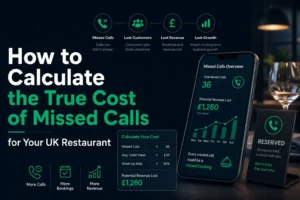
- 10 missed calls per day x £25 per order = £250/day lost revenue
That is:
- £7,500/month
- £90,000/year
In Birmingham, This Problem Is Even Bigger
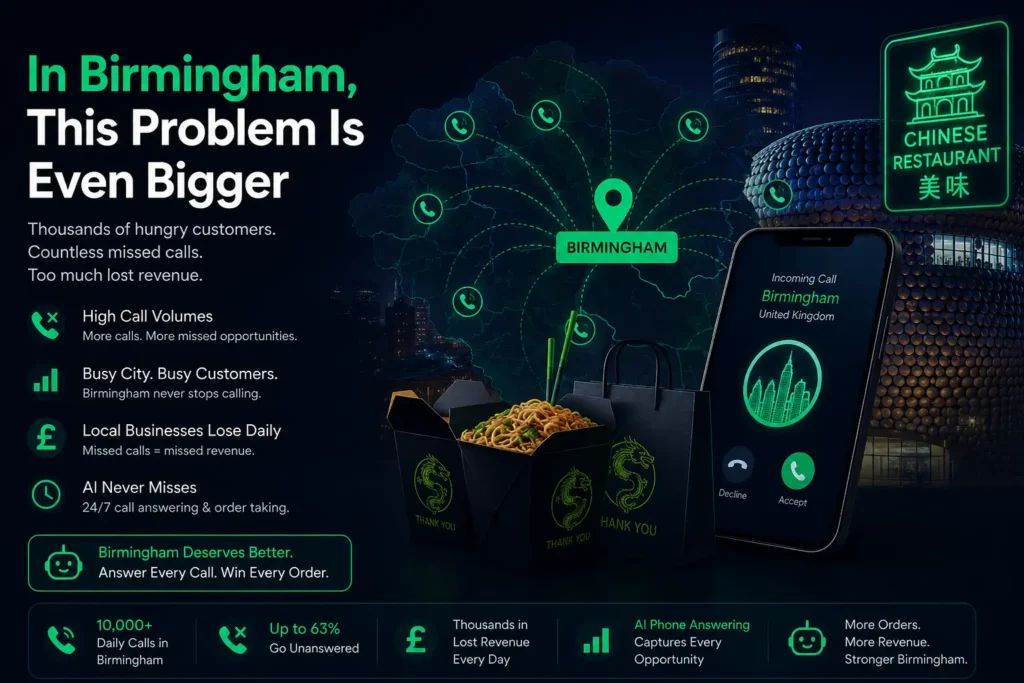
The city of Birmingham is one of the UK’s fastest-growing food service markets, with intense competition across every major dining and takeaway area. Chinese restaurants in particular operate in some of the busiest, most saturated food districts in the country, where speed of response directly impacts revenue.
Chinese food demand is consistently strong across Birmingham, especially in high-footfall and high-density hospitality zones such as Birmingham Chinatown in Southside, Broad Street, and Edgbaston, where dine-in restaurants, late-night takeaways, and delivery-driven businesses operate side by side.
In Southside’s Chinatown, where competition between authentic Chinese restaurants is particularly concentrated, even a short missed-call window can mean losing a table booking or multiple takeaway orders in a single peak period.
On Broad Street, where late-night demand is high due to bars, hotels, and nightlife traffic, restaurants face constant incoming calls that need instant response. Any delay results in lost orders that are quickly absorbed by nearby competitors.
In Edgbaston, where higher-end Chinese dining and delivery services compete for residential and professional customers, consistency and responsiveness are critical. Customers expect immediate answers, and slow response times directly translate into lost repeat business.
Chinese restaurants are also highly concentrated in cities like Bradford, where strong demand and dense clusters of independent takeaways create similarly competitive conditions. Across all of these areas, restaurants that successfully capture and respond to every phone call consistently outperform those relying on manual handling or missed-call recovery.
What Is AI Phone Answering for Chinese Restaurants?
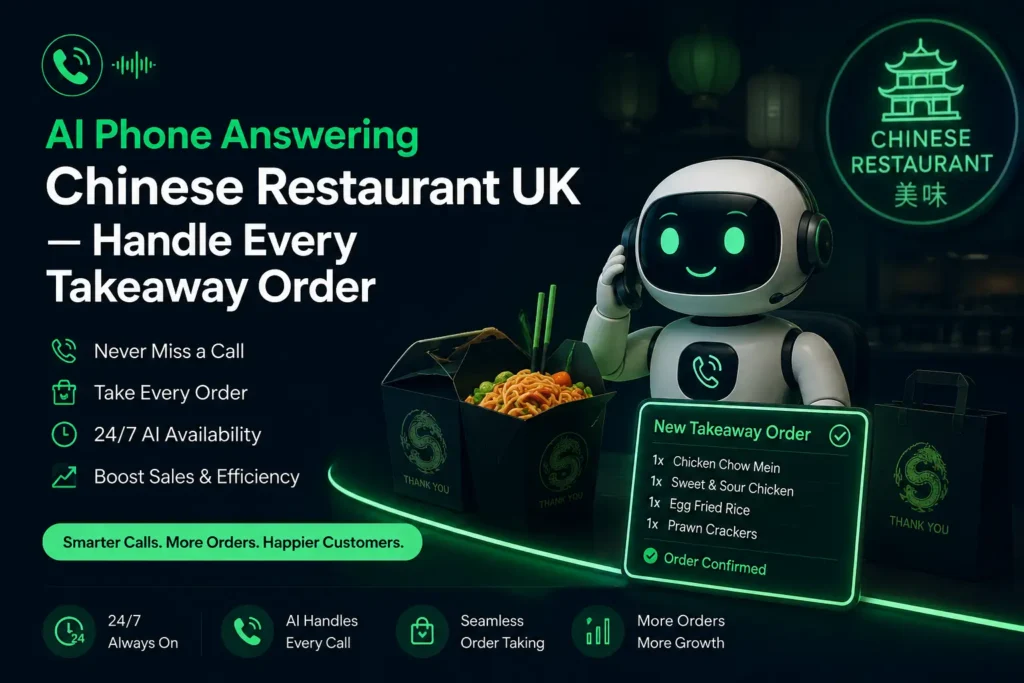
With intelligent phone answering, like Callopa, it handles calls and customer orders digitally and automatically. Unlike previous phone ordering systems, Callopa’s intelligent phone ordering does not utilise:
- Button-based menus
- Recorded responses
Instead, Callopa understands natural conversation. With “AI phone answering Chinese restaurant UK”, your customers simply make an order, without you ever needing to lift a finger.
How Callopa Works for Chinese Takeaways
Callopa is designed specifically with real takeaway ordering systems in mind. Here is exactly how it works in your restaurant:
1. All Calls are Answered Without Delay
Your customers hear:
“Good evening, thank you for calling [Restaurant Name]. How can I help you today?”
When you are not available for takeaway orders.
2. Callopa Takes the Order
Callopa is designed to understand:
- Dish names
- Food Variants
- Dish Modifications
As an example, there is no confusion with Callopa when someone orders “Sweet and sour chicken, no peppers, extra sauce”.
3. Understands the Complexity of Menus
Callopa understands the complexities of Chinese menus, having:
- 100+ Menu Items
- Combinable Items
- Menu items with nearly identical names
4. Callopa Understands Dietary Restrictions
Callopa understands the dietary inquiries of customers:
- What is vegetarian?
- What contains allergens?
5. Order Is Confirmed
Before the order is completely finished, the customer is prompted to confirm their order. AI Phone systems with Callopa reduce errors by confirming each order.
6. Order Sent to Your WhatsApp Instantly
Callopa does not need complicated systems like POS integration or elaborate system setups. Once an order is confirmed, Callopa sends it directly to your WhatsApp.
Beyond Orders — Improving Your Whole Operation
Callopa is more than a call answering service. It can transform your restaurant operation:
Your Staff Focus on Cooking
Reduced interruptions. No more of your staff personally answering the phone during service.
Customers Get Instant Service
Callopa ensures that no customers become frustrated with poor customer service or poor service time.
You Capture More Revenue
Callopa gives you the ability to answer every phone call and collect from every opportunity.
Pricing Made Clear and Simple
Callopa pricing is simple and transparent with no hidden fees or charges.
- Starter — £149/month
- Growth — £299/month
- Professional — £499/month
- Enterprise — £899/month
Every restaurant that employs Callopa recovers its costs after the first week.
Implementation Process of Callopa (Simple Setup)
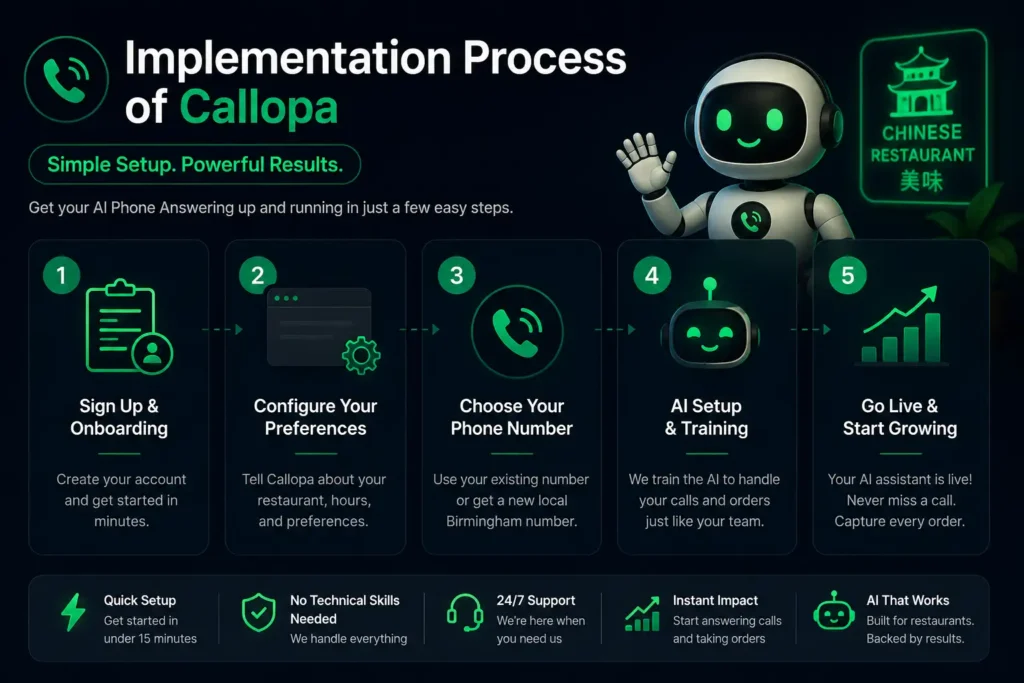
Callopa is designed for fast implementation compared to traditional systems. The core setup includes:
- Menu configuration
- Call flow setup
- WhatsApp connection
- Business onboarding
There is no need for:
- Point of sale integration
- Technical installation
- Downtime
Importance of Callopa
Chinese food is still the most searched and ordered food in the UK. Since demand is already there, you cannot generate revenue due to unanswered calls. Without answering calls, you are:
- Missing orders
- Missing potential buyers
- Missing a portion of the market
What Makes Callopa a Success
Callopa is an AI phone ordering system. It is created to serve specific industries:
- UK food delivery and takeaway setups
- The food industry that receives high orders by phone calls
- Complex menu structures
- Chinese restaurants that have specific workflows
It was created with only one goal:
- To never miss a call
Every Call Is Revenue
Chinese food’s success in the UK is based on one simple action:
- Answering the phone call.
That’s it.
- Not marketing.
- Not menu size.
- Not their location.
If the phone call is answered:
- You get the order.
Not answered:
- You lose business.
Your restaurant works too hard to miss a call.
Book a free demo and hear Sarah answer in real time.